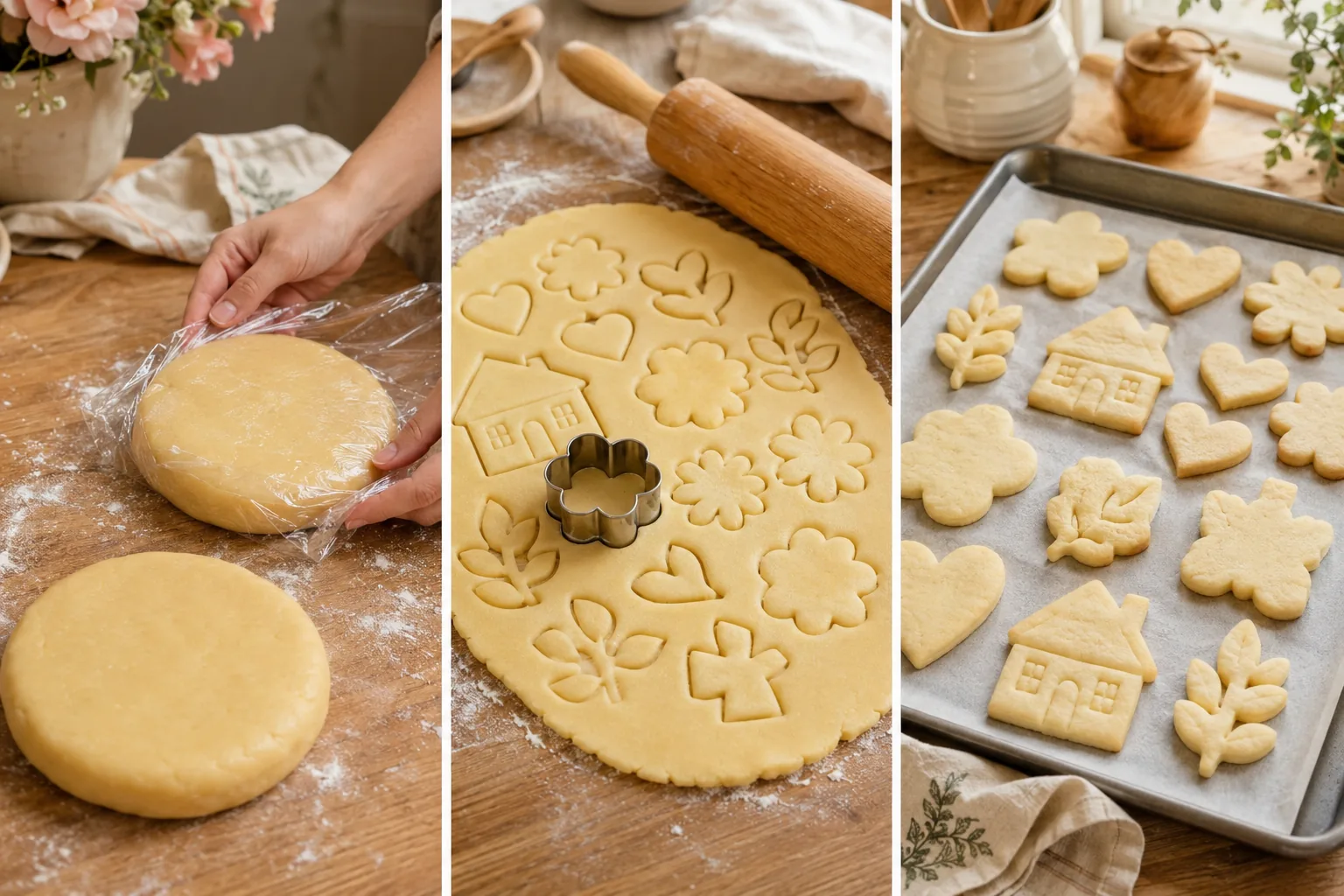
Soft cut-out sugar cookies with clean edges, an evenly rolled chilled dough and clear pale-doneness cues for decorating.
Dietary labels are based on the listed ingredients. For allergies or celiac disease, verify every packaged ingredient and guard against cross-contamination.The original handwritten card specifies approximately 7 minutes. Because cutter size, dough temperature and pan colour affect baking, the original cue is preserved within a practical 8- to 11-minute range for 1/4-inch cookies.
FROM JO’S RECIPE NOTES
Why this recipe works
Icing sugar dissolves smoothly into the butter and helps create a tender, fine-textured cookie.
Dividing the large batch into four flat portions lets the dough chill and roll evenly.
Rolling between parchment limits the extra bench flour that can make rerolled cookies dry.
Chilling the cut shapes for 10 minutes keeps the butter firm, helping the edges stay defined.
Removing the cookies while they are dry and set but still pale preserves the intended soft centres.
Ingredient notes
Butter
Use cool room-temperature butter that dents easily but still looks matte. Melted or greasy butter encourages spreading.
Icing sugar
Weigh 240 g and sift only if lumpy. Do not substitute the same volume of granulated sugar; it changes the dough texture.
Flour
Weigh 600 g or spoon lightly and level. Keep extra rolling flour minimal by using parchment.
Eggs
Room-temperature eggs blend more evenly into the creamed butter, but the raw dough must not be eaten.
Practical substitutions
These are conservative alternatives based on standard kitchen practice; results may vary from the original recipe.
Replace up to 1/2 teaspoon of vanilla with almond extract if desired, unless serving someone with an almond allergy.
A one-for-one gluten-free baking blend is an unverified adaptation and may spread or crack differently; it should not be presented as equivalent to Jo’s documented formula.
Troubleshooting
The cookies spread
Keep the butter cool, chill the dough fully, place shapes on a cool pan and chill the filled tray for 10 minutes before baking.
The dough cracks while rolling
Let one chilled portion stand for 3 to 5 minutes, then roll between parchment. Do not add liquid before giving the butter time to soften slightly.
The dough sticks
Return the rolled sheet to the refrigerator for 10 minutes and peel the top parchment away before cutting.
The cookies are hard
Measure flour without packing, reroll scraps only once and remove the cookies while the tops are pale and matte rather than browned.
Some shapes bake faster
Group similar-size shapes on the same tray and keep every piece at an even 1/4-inch thickness.
Storage and freezing
Store completely cooled undecorated cookies airtight at room temperature for up to 5 days. Store decorated cookies at room temperature only when the chosen icing recipe explicitly permits it; otherwise follow that icing’s refrigeration guidance.
Freeze baked cookies between parchment for up to 2 months. Thaw them in the closed container before decorating.
Freeze airtight dough portions for up to 2 months. Thaw overnight in the refrigerator, then let one portion soften only enough to roll.
THE BUTTER & BLOOM RECIPE
Classic Cut-Out Sugar Cookies
Print-friendly layout
Preparation time
35 min
Cooking time
40 min
Total time
2 hrs 15 min
Yield
about 48 three-inch cookies (estimated)
Cuisine
North American
Updated
Ingredients
2 cups (454 g) unsalted butter, softened to cool room temperature
2 cups (240 g) icing sugar, sifted if lumpy
2 teaspoons pure vanilla extract
2 large eggs, at room temperature
5 cups (600 g) all-purpose flour, spooned and levelled
1 teaspoon fine salt
1/2 teaspoon baking soda
Detailed directions for Classic Cut-Out Sugar Cookies
Cream the butter and sugar — Beat the cool softened butter and icing sugar with an electric mixer on medium speed for 2 to 3 minutes, scraping the bowl once, until smooth, pale and creamy. Stop before the butter becomes shiny or greasy, which encourages spreading.Classic Cut-Out Sugar Cookies · AI instructional image: Cream for 2 to 3 minutes while the butter remains cool and matte.
Add the eggs and vanilla — Beat in the eggs one at a time on medium-low speed, waiting until each is incorporated before adding the next. Mix in the vanilla and scrape the bowl; the mixture should look smooth and emulsified.Classic Cut-Out Sugar Cookies · AI instructional image: Incorporate each egg fully before adding the next, then mix in vanilla.
Whisk the dry ingredients — In a separate large bowl, whisk the flour, salt and baking soda for about 30 seconds. Break up every flour pocket so the small amount of baking soda is distributed evenly.Classic Cut-Out Sugar Cookies · AI instructional image: Whisk for 30 seconds to distribute the baking soda evenly.
Make the dough gently — Add the dry mixture to the butter mixture in three additions on low speed. Stop mixing as soon as the last dry streak disappears and the soft dough holds together. Do not taste dough containing raw flour and eggs.Classic Cut-Out Sugar Cookies · AI instructional image: Mix on low only until the dough comes together; never taste raw cookie dough.
Divide and chill — Divide the dough into four equal portions and flatten each into a 1-inch-thick rectangle. Wrap airtight and refrigerate for at least 1 hour or up to 2 days. Flat portions chill evenly and are easier to roll than one large block.Classic Cut-Out Sugar Cookies · AI instructional image: Divide into four flat portions and refrigerate for at least 1 hour.
Roll evenly — Position a rack in the centre of the oven and preheat to 325°F (165°C). Roll one cold dough portion at a time between two sheets of parchment to an even 1/4-inch thickness. If it cracks, let it stand for 3 to 5 minutes; if it feels sticky or soft, chill the rolled sheet for 10 minutes.Classic Cut-Out Sugar Cookies · AI instructional image: Roll one cold portion at a time to an even 1/4 inch.
Cut, transfer and chill — Cut shapes as closely together as practical. Lift them with a small offset spatula onto cool, parchment-lined light-coloured metal sheets, spacing them 1 inch apart. For 3-inch cutters, plan on roughly 12 cookies per tray and four trays for the full batch; the exact count varies with the shapes. Gather scraps once, press together without kneading and reroll. Chill each filled tray for 10 minutes for the cleanest edges.Classic Cut-Out Sugar Cookies · AI instructional image: Space the cut cookies 1 inch apart and chill the filled tray for 10 minutes.
Bake pale, then cool — Bake one tray at a time for 8 to 11 minutes, rotating once if the oven browns unevenly. Allow about 32 to 44 minutes of oven time for four trays, and cool a used pan before placing the next shapes on it. The cookies are done when the surfaces look dry and matte and the edges are set but still pale; a faintly golden underside is enough. Cool on the pan for 5 minutes, then transfer to a rack and cool completely before decorating. Store airtight for up to 5 days or freeze for up to 2 months.Classic Cut-Out Sugar Cookies · AI instructional image: Bake until dry and set but still pale, then cool completely before decorating.
Keywords: soft cut out sugar cookies · sugar cookies that hold their shape · cut out cookies for decorating · no spread sugar cookies · soft Christmas sugar cookies · make ahead cut out cookie dough
Published · Updated
READER REVIEWS
Be the first to review
☆☆☆☆☆
Loading reviews…
COMMON QUESTIONS
Classic Cut-Out Sugar Cookies FAQ
How thick should I roll cut-out cookie dough?
Roll it evenly to 1/4 inch for soft centres and sturdy shapes. Thickness guides help the entire tray finish together.
Do I need to chill the dough?
Yes. Chill the divided dough for at least 1 hour and chill the cut shapes for 10 minutes to reduce spreading.
How long does the full batch take to bake?
At roughly 12 three-inch cookies per tray, the estimated 48-cookie batch needs about four trays. Baking one tray at a time takes about 32 to 44 minutes in total, not merely the 8 to 11 minutes required by one tray.
Can I make the dough ahead?
Yes. Refrigerate the wrapped portions for up to 2 days or freeze for up to 2 months.
Can I eat the raw dough?
No. Health Canada advises that raw flour and raw eggs may contain harmful bacteria and cookie dough should be baked before eating.
How do I know pale sugar cookies are done?
Their tops should look dry and matte, the edges should feel set and the undersides may be faintly golden. The tops should not brown deeply.
KEEP EXPLORING
Recipes to make next
Continue with these closely related recipes from The Butter & Bloom kitchen.